StillHaus

Digital Cultural Space
Fallacy & Reflections — Summer 2026
Where silence becomes color.
Approach each work slowly. The room will answer.
Fallacy & Reflections — Summer 2026
Approach each work slowly. The room will answer.
About StillHaus
StillHaus is a digital cultural space shaped for slow looking. It is not built as a portfolio, archive, or spectacle, but as a restrained environment where images can be approached as emotional architecture.
Its explorable-room form was partly sparked by watching my child move through Minecraft worlds, and wondering whether an art gallery could also become a world to enter.
The work unfolds through atmosphere: dim thresholds, careful typography, softened controls, and moments of discovery that ask for patience rather than performance.
Each exhibition is treated as a temporary interior. Visitors move through it as they might through a small museum after closing: gently, privately, and with enough silence for the images to answer.
Current Exhibition
This first room begins with the self and moves toward reflection, uncertainty, and non-duality.
The journey unfolds through six thresholds, drawing on Vedantic philosophy: aham (I), bimba (there is me), pratibimba (there is my reflection), māyā (the boundary becomes uncertain), sākṣī (witness-consciousness), and advaita (non-duality).
As visitors approach the works, ancient words rise briefly from the floor. They are not labels for the artworks, but moments of passage. The room asks the visitor to move slowly enough for meaning to appear.
About the Artist
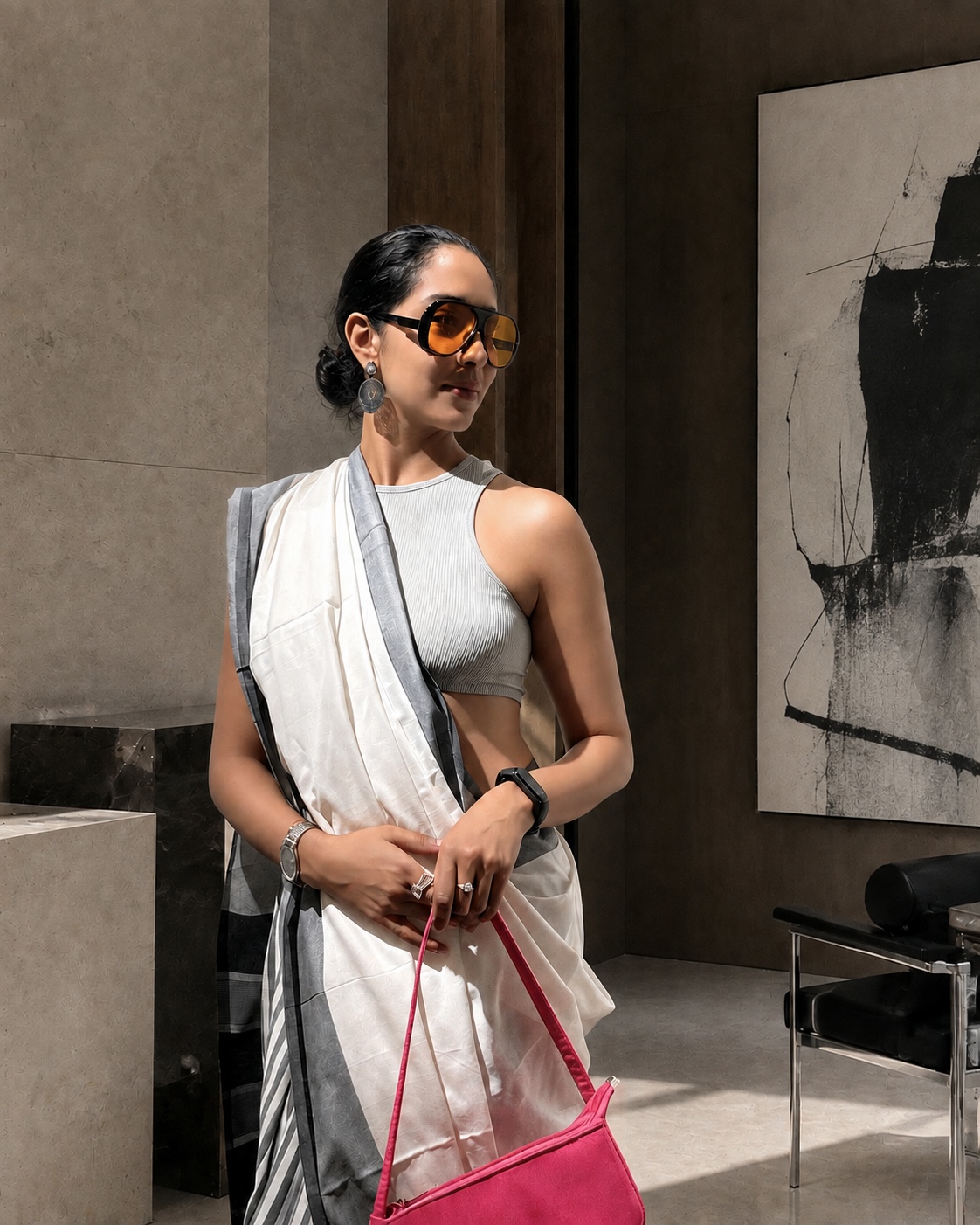
Rajini Preetha John is an interdisciplinary artist and machine learning engineer whose practice moves between technology, language, philosophy and lived experience, examining questions of identity, perception, consciousness and the nature of what we call real.
Born in India and rooted in Kannada, her mother tongue, John grew up within a multilingual cultural landscape shaped by Sanskrit as well as Hindi, Tamil, Telugu and Malayalam. Her life later expanded across countries and cultures, from India to China and Malaysia, with an increasing connection to Germany. This movement between languages and places has become part of the way she understands identity itself: inherited and remembered, yet continually translated, reflected and reconstructed.
Her work repeatedly returns to ideas rooted in Indian philosophical traditions: bimba and pratibimba — image and reflection; māyā — the instability of what appears to be real; and Advaita — the possibility that the distinction between observer and observed, self and other, may ultimately dissolve.
John approaches these ideas not as doctrines to explain, but as questions she continues to live with.
Alongside her artistic practice, she works with data science and machine learning — systems concerned with patterns, models and making meaning from complexity. Her artistic work occupies the tension between what can be measured and what may resist measurement altogether.
StillHaus is the evolving digital architecture in which these strands converge.
At the centre of her practice is a recurring question:
How do we know what is real?
Next Room Invitation
Stillhaus changes in rooms. Receive a quiet note when the next room opens.
I’ll send a quiet note when the next room opens.
If something here stayed with you, you may also leave a letter for the artist.
Process & Map
Fallacy & Reflections began as a question rather than a fixed answer: how does a self become visible, split into image and reflection, and then lose the certainty that either one is original? StillHaus holds that question as an explorable digital room.
The exhibition combines digital image-making, spatial sequencing, code, language, and sound. Each artwork is placed as a threshold in a quiet gallery, while Sanskrit and Kannada-rooted concepts rise briefly through the visitor's movement. The text does not explain the images from outside; it appears as part of the act of crossing.
Concept Board
A condensed view of the exhibition's six thresholds, word movement, navigation language, and design atmosphere.
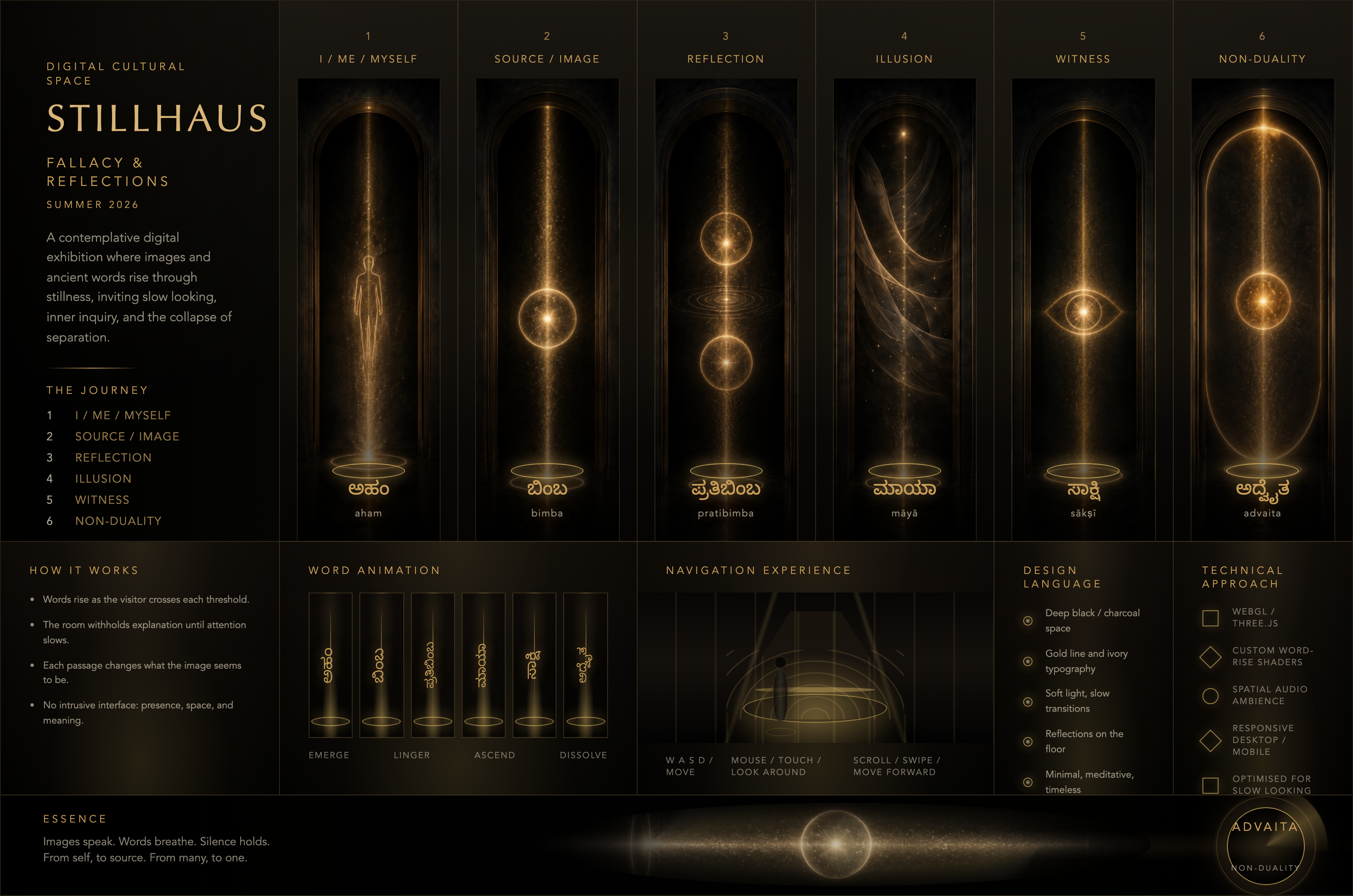
Layout Diagram
Technical Notes
Medium: interactive web-based digital installation and virtual gallery. Materials: digital paintings, browser-rendered 3D space, sound, typography, written narrative, and visitor interaction. Dimensions: variable, responsive to screen and device. Tools: Three.js, JavaScript, HTML, CSS, Vite, image editing, and web-hosted deployment through Netlify on the StillHaus .ART domain.
Authorship
The conceptual structure, sequencing, writing, image selection, visual atmosphere, and final digital architecture are authored by Rajini Preetha John. Code and software are used as studio tools: not to replace authorship, but to shape the conditions through which the work can be entered, paced, and remembered.
Reach the Artist
Letter Received
If a reply is meant to return, it will find its way back.
By RPJ
Description of the artwork will appear here when you approach a piece.